
Every year, 32.5 billion metric tons of carbon dioxide are released into the atmosphere. This layer of carbon dioxide in turn acts as an insulating blanket around earth which does not let heat escape, hence causing global warming. So how do a few species of tiny fish help cool Earth down? What makes these Lanternfish the most important fish in the ocean? Are they the light of hope in our fight against climate change?
To answer these questions, we need to travel roughly a hundred years back in time.
Scene 1: A brief history of marine ultrasonics
Since the inception of marine echo-sounding in the 20th century, humans have picked up strange echos from the depths of the ocean. These echos were so widespread that marine experts first thought that they have hit the ocean floor. Later studies revealed that this couldn’t possibly be the case. The US Navy was afraid that this ‘Deep Scattering Layer’ would make it difficult for them to locate foreign vessels near the sea floor. The Question had to be asked, what exactly forms this deep scattering layer?

The answer was found by a team of marine biologists in the 1940s, when they found that the layer seems to move up and down in the water column throughout the day. During the day, the layer used to be found between the depths of 400m and 600m, towards the dusk however, this layer came really closed to the surface. These echos happened everyday and made fish their most probable source. These were known to humans since the 19th century and were known as diel vertical migrations.
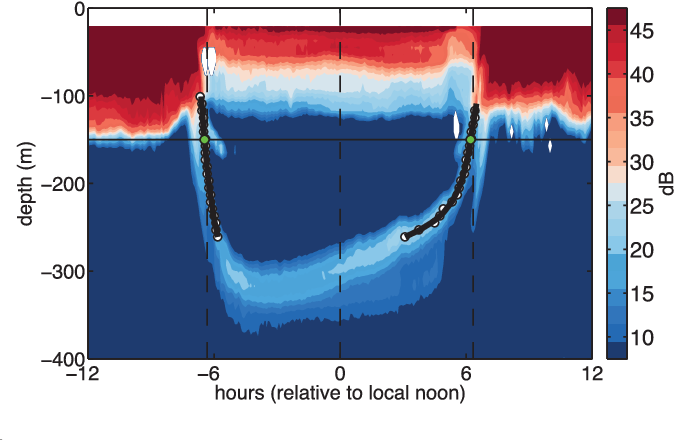
What was surprising was the extent of these migrations, these stretched far and wide for hundreds of miles across the oceans of the globe. The main culprit of this mind blowing phenomenon, was as you may have guessed by now, the Lanternfish.
Scene 2: Lanternfish
Lanternfishes are small mesopelagic fish of the large family Myctophidae. One of two families in the order Myctophiformes, which mostly dominates the twilight zone. Lanternfish make upto 65% of the deep sea biomass. They feed on tiny planktonic animals, making vertical migrations of as much as 400 m (1,300 ft) or more to follow the nightly movements of the plankton to surface waters.They carry these vertical migrations out with the help of an air bladder present inside them. They move in large schools and, in the Mediterranean area, are known to breed from April to July.
However, we still have a lot more to learn about lanternfish, since they, just like most mesopelagic organisms are really good at avoiding nets and traps. Lanternfish have a special sensory organ called the lateral line system which is a series of canals that sense minor changes in water pressure caused by low frequency vibrations and helps them avoid predators.

They also have another trick up their sleeve to avoid predators called bioluminescence. They have small organs called photophores scattered across their body which helps them produce their own light! These fish are an important food resource for both large marine animals and predatory sea birds. Their importance for humans however, is far beyond just food.
Scene 3: The Carbon Cycle
Considering that the mesopelagic fish comprise 90% of the oceans area and 20% of its volume, it is one of the largest ecosystems found on the planet. Scientists earlier estimated that the total weight of this biomass is about a billion tons (1 gigaton), now however, further studies conclude we never have been more wrong. The biomass weighs upto 5 and 10 gigatons, the weight of upto 250 billion people! Lanternfish alone comprise 6 gigatons of the biomass, outnumbering and outweighing all other fish of this area combined.
Most carbon entering the atmosphere is pumped into and out of the ocean through a natural physiochemical process called the carbon cycle. However there is also a considerable amount of carbon which is moved into the oceans by the biological pump, whose power had been severely underestimated till recent times.
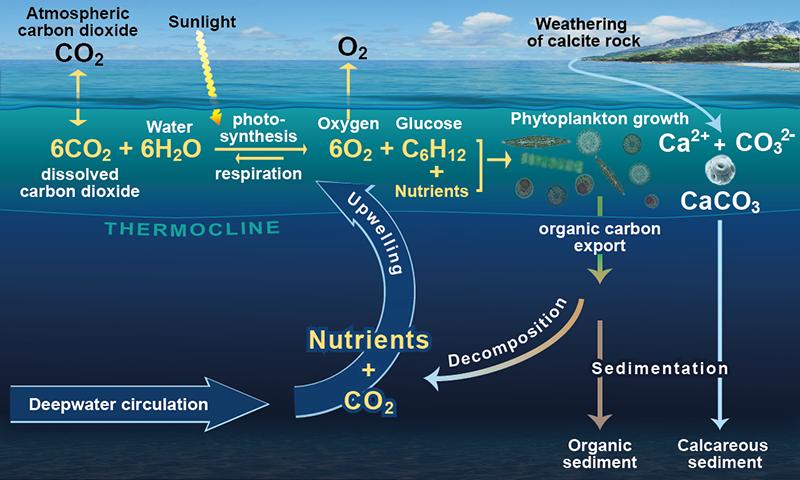
At first, the carbon is converted from its inorganic gaseous form (CO2) to its organic form, glucose by a process called photosynthesis done by phytoplanktons. These primary producers are in turn consumed by crustaceans and other zooplanktons, the herbivores of the ocean and then continuously by larger and larger predators. This process for years and at times decades. The remains of this cycle and other waste falls down to the deeper parts of the ocean and is known as Marine Snow.
This Marine snow in turn acts as the primary food source for deep sea organisms. Hence the organic carbon produced at the surface is slowly consumed by the deep sea, being trapped there for hundreds, thousands and even millions of years. This however is also not the only cycle which contributes in the carbon pumping systems.
Scene 4: Lanternfish vs. Climate Change
Let us rewind to the part about the dieal vertical migrations. By consuming organic matter on the surface at night, the lanternfish exports tens of millions of tons of food, which otherwise would remain at the surface, to the mesopelagic and deep sea layers every night, and with it, enormous amounts of carbon. Estimates show that even if lanternfish consume only 5% of its body weight a day, it will only take them a week to consume the carbon weight equivalent to the whole human population. Hence this active transport of carbon carried out by the lanternfish is responsible for over one third of the carbon carried to the deep sea annually (about 11 gigatons). This means that the lanternfish might remove about half of the carbon produced by humans through burning of fossil fuels each year.
Conclusion:
These however are really rough estimates but they showcase why we need to study the ocean, which is an important gear in the global carbon cycle. It is simply magnificent how this part of the carbon cycle is run by millions of organisms we know very little about, simply because how tough is it to study them. This though, can turn out to be really detrimental in the future. Although there are only a handful of mesopelagic fisheries globally today, this can change really quickly. The rising demand for marine protein and this one very huge untapped resource, makes mesopelagic fish really vulnerable to more anthropogenic scrutiny.
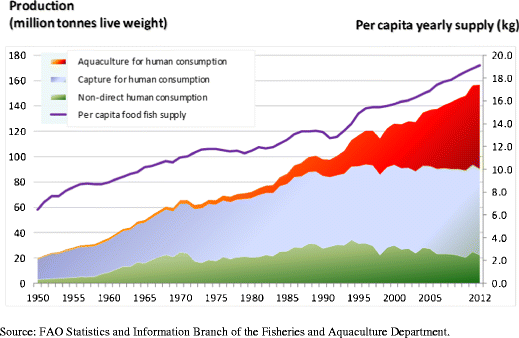
This seems almost inevitable, and if not used sustainably, will have consequences far beyond just the surface, in turn making this a high stakes game. Humans, now have to make a wise choice, which although is very unlike their behaviour. Time and again, we humans, have put our ecosystem to repetitive scrutiny for capitalist gains.
 HAEVYRE
Leave a comment