
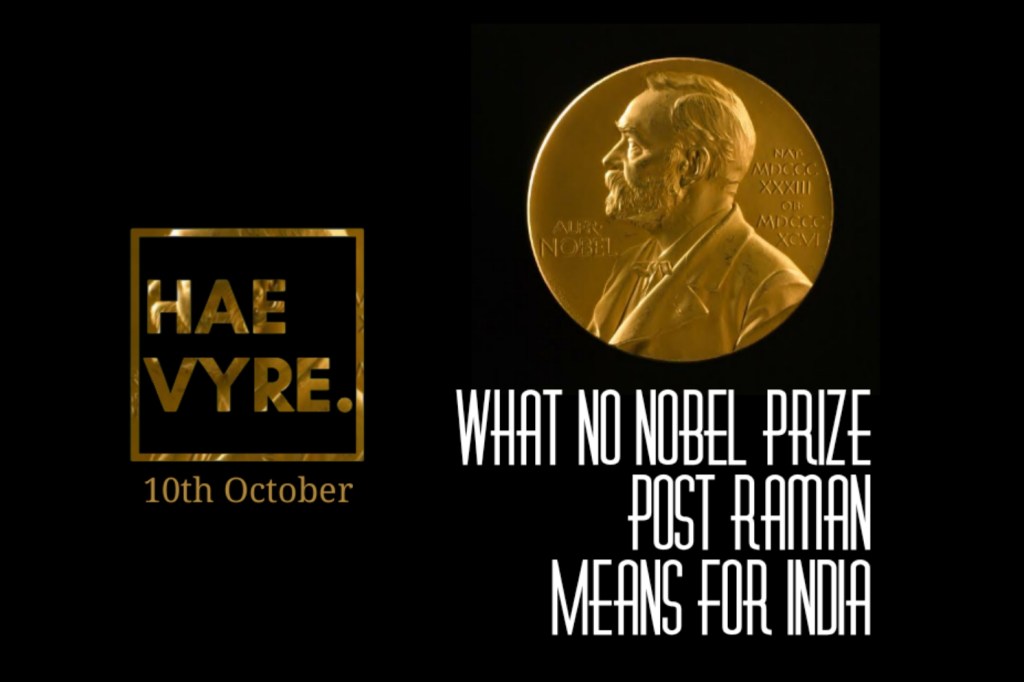
No better time to analyse Indian Science than the week of Nobel Prizes. The week, where very established scientists from across the globe, with a blazing trail of legacy behind them, were awarded this very illustrious honour of being a Nobel Laureate. This honour though hasn’t reached India ever since 1930. The first and the only Nobel Prize in Science for India was won by Sir C.V. Raman. Don’t get me wrong here, Nobel prizes aren’t the only means to measure the success in science of a person or an institution, but the lack of Nobel Prizes are. 90 years down the line, we still await our Prize, so the question remains, ‘What went wrong?’
- Curriculum
Massachusetts Institute of Technology (MIT) has had 97 Nobel Laureates as of October 2020, ten of whom are still a working faculty at MIT. India on the other hand, has failed to produce any such institution, which let alone delivers Nobel Laureates at a good rate, but at-least manages to produce one. So it would be fair to ask, what are the most premier institutes of India lacking? Well for starters, the will, followed by the curriculum.
As counter-intuitive it may sound, the Indian Institute Of Technology (IIT) which has an acceptance rate of just 0.7% (10 times less than that of MIT) lacks the curriculum required to win the Prize. IITs in the global arena stand way behind most universities, IITB is yet to make its way to the top 100. The very old, discarded and disregarded curriculum of India has played a very vital role in pulling the country behind.
2. The will
Over nine lakh students gave the JEE Main exam in 2020, at the same time over sixteen lakh students gave the NEET exam. St. Stephens College’s cut of sky rocketed to an all time high of 99.25%. So it is pretty apparent that India has its fair share of young, aspiring, budding Nobel Laureates. Well, error 404, will not found. Don’t believe me? As far as the topper (AIR 1) of the JEE Advanced exam, preferred MIT over any other IIT, and as most students say, anyone in their sane mind, would. The AIR 4 too would be flying to CalTech soon. Now in theory, brain drain should be criticized, but if you or I would be in his shoes, would we have given IITs a second thought?
Most government funded universities of India lack the infrastructure (technology, faculty and funding) to aid ground breaking research in any field. With a cumulative acceptance of mere 27%, Indian Universities have surely broken more dreams than they have helped come true. Ivy league colleges for us Indians, feel like the biggest achievement one can get in their lives, and hence, we stop there. No scientist with an Indian origin except Har Gobind Khorana has won the Nobel Prize.
3. Society, Parents and the general perception of Science
Being a science student, I find myself capable to write this part. The society though always finds Science students to be brighter than students of other streams, it still ironically fails to support science students. Every parent of a science student wants them to become an engineer or a doctor, though a bachelor’s degree in science has always been an option to fall back upon, to the extent that parents would rather prefer a private college over a government college providing a B.Sc degree.
Parents though, aren’t completely to be blamed, a B.Sc degree in India doesn’t come with many opportunities, but certainly a lot of struggle. If a student fails to become an engineer or a doctor from a good university, they are looked down upon. Reservation in such universities is of no help to general category students either.
The perception of science isn’t good either. Certainly not among the students who study science. A common trend that I followed amongst similar students is that nobody perceives it as a means to get knowledge. Everyone is just in a race, to get to the IITs, due to which the coaching sector in India has become a factory of pumping out 99.5% broken dreams, though this is the topic for a completely different blog altogether. Students find physics to be tough, chemistry to be illogical and biology to most feels like a subject that should just be mugged up. Most students fail to see the logic behind it.
Things to take away from this article
I by no means want to demean the great scientists of India. Nor am I putting a question mark on their capabilities. The only thing stopping us from becoming a superpower in science is the fact the lack of very basic stuff in this sector. Given the right equipment, facilities, faculty and funding, India would be all set to win the first Nobel Prize in Science in almost a hundred years. I wish the very best to all the genuinely budding scientists and big thinkers.
PS. This certainly calls for a follow up part, the Indian perspective to the larger scheme of things in science.
 HAEVYRE
Leave a comment